
So, I’ve recently finished my first assignment for my MA in Music Business and I thought it would be worth sharing some of the thinking behind it here, because a lot of it touches on things that have been rattling around in my head for a while — things about Stoke, about live music, about who I am and where I’m trying to go.
The assignment asked me to think critically about where I sit in the music industry and how I might build something sustainable within it. It was one of those tasks that starts as an academic exercise and ends up being something much more personal.
The core idea is pretty simple. I want to promote live music in Stoke-on-Trent. Not just one genre, not just one crowd — all of it. Rock, classical, folk, whatever. And I want to do it affordably. Because here’s the thing: Stoke is one of the lowest-earning cities in Britain. Average weekly wages here are around £465, compared to £751 in London. Ticket prices across the industry have gone through the roof over the past few decades. The two things simply don’t add up for a lot of people, and that bothers me. Culture shouldn’t be a luxury. It should be accessible to everyone.
Most of you know that I work at Music Mania. On the surface we’re a record/CD shop and ticket agent. Behind the scenes though, we’ve been producing and promoting shows for years. That side of things is where my heart is. My original plan was to learn directly from Mike Lloyd, who has been promoting music in the area since 1970. As most of you will know from my last post, Mike passed away in December. From a personal standpoint, it was devastating. It also left a significant gap professionally and I had to reassess a lot very quickly.
Writing this assignment helped me do some of that reassessing in a structured way, and I think that was genuinely useful.
One of the things I had to be honest about was the challenges involved. Financial sustainability is the big one. If you’re keeping ticket prices low, you’re working with thinner margins, and that requires some creative thinking about where the money comes from. I’ve been exploring this through multiple revenue streams — booking fees, acting as a box office for other promoters, and applying for funding through organisations like Arts Council England. I work closely with Stoke-on-Trent Festival, a local charity focused on bringing classical music to the area, and they’ve secured Arts Council funding which takes a fair bit of financial pressure off certain shows.
Then there’s the question of brand. Covering multiple genres is something I feel strongly about, but it does create a risk — you can end up standing for nothing in particular if you’re not careful. I looked at this through the lens of branding theory and the conclusion I came to was that the brand needs to be the constant, not the genre. Think of it a bit like Virgin — whether it’s airlines or music or mobile phones, you always know it’s Virgin. The community-first, accessibility-driven identity has to be what people associate with the business, not any specific type of music.
I also did a competitor comparison looking at The Sugarmill, The Underground, and Mitchell Arts Centre. I use the term competitor very loosely as I see these as partners and allies, all bringing their own thing to Stoke-on-Trent. I want to combine multi-genre programming with an affordability-led mission and I feel that that’s the gap and the space I want to occupy.
There’s a section in the assignment about values and, honestly, that part surprised me a bit. I did a personality test and a values exercise as part of the process, and sitting down to actually name the things that matter to me — family, trust, respect, ethics, loyalty — made me realise how directly those things connect to what I’m trying to build professionally. There’s a reason I care about accessibility. Early in my life I was told I had no worth as a musician because I couldn’t read notation. That stuck with me. Bourdieu would call it cultural capital — the way institutions can quietly exclude people who didn’t come up through the “right” channels. I’ve never forgotten what that felt like, and I don’t want anyone in this city to feel like live music isn’t for them.
There are some genuine weaknesses in what I’ve put together, and I was critical about those too. My customer segmentation isn’t refined enough yet. I don’t have a proper data capture strategy in place. The revenue model is still too reliant on ticket sales and external funding. These aren’t insurmountable problems, but they need addressing, and I’ve set myself some SMART objectives to tackle them — building a proper CRM system through the Music Mania ticketing portal, diversifying into sponsorships and merchandise, and eventually developing proper psychographic audience profiles so marketing can be genuinely targeted rather than scattergun.
The biggest takeaway for me personally is that having a good idea and good values isn’t enough on its own. You need the operational structure to back it up. I came into this with a lot of passion and a clear sense of what I wanted to do, but a somewhat vaguer sense of the how. That’s shifting now. I’m learning to think more strategically and less purely creatively, and whilst that doesn’t come as naturally to me, I think it’s genuinely making me better at this.
There’s still a long way to go, but I’m swimming, as I said last time. Just about!
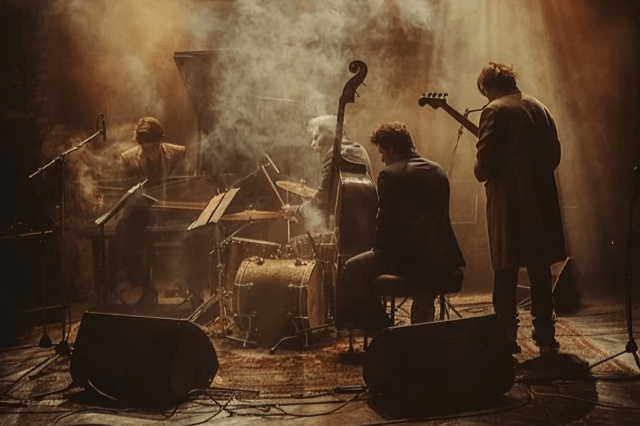
Featured image from Stockcake (artist unknown)
 David Shingler's Stream of Consciousness
Leave a comment